
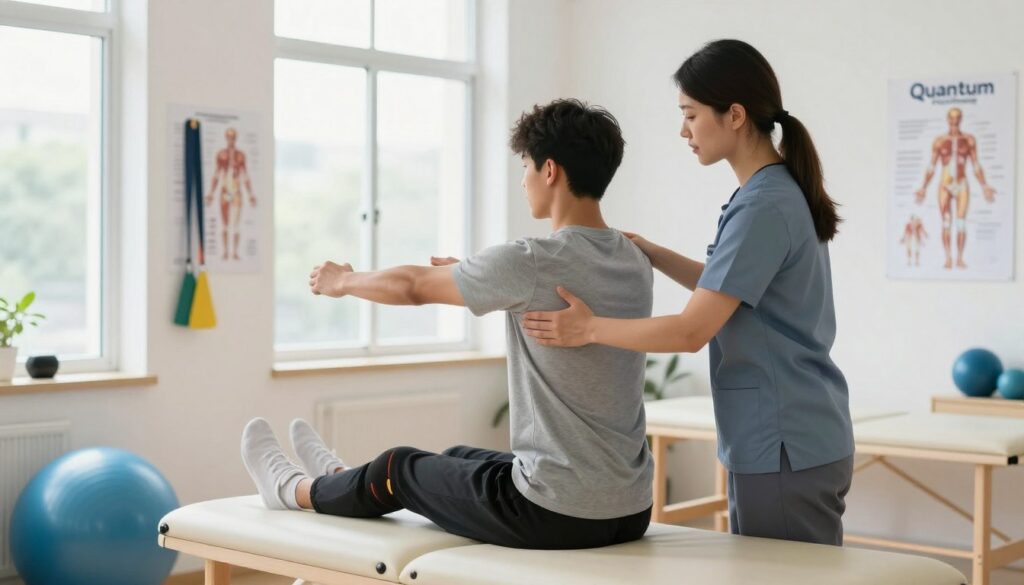
Welcome to our sports injury service, designed for people training at any level across India. We focus on both prevention and recovery so you can return to activity faster and safer.
Our teams at Holy Spirit Hospital and KD Hospital offer evidence-based, patient-centred rehabilitation that restores mobility, function and confidence. Care is delivered using modern modalities and personalised programmes tailored to each person’s goals.
We describe a structured pathway: early pain control, progressive rehabilitation, and long-term re-injury reduction through movement quality and load management. This approach makes recovery measurable, not guesswork.
You will find clear guidance on conditions treated, assessment steps, treatment options including manual techniques and modalities, exercise therapy, and prevention advice for everyday training. The aim is not only symptom relief but to restore function and quality life, so patients move confidently at work, at home and in sport.
Plans are personalised with regular progress reviews and education to maintain results between sessions. Expect staged goals and objective criteria for return to play.
Key Takeaways
- Structured care promotes faster, safer return to activity.
- Early pain control and progressive rehabilitation are central.
- Personalised plans and regular reviews keep recovery on track.
- Treatment mixes manual techniques, modalities and exercise therapy.
- Goal: restore function and long-term quality of life, not just relieve symptoms.
Sports injury physiotherapy in India: prevention, treatment and faster recovery
A personalised approach combines hands-on treatment and movement retraining to restore performance. KD Hospital uses a holistic assessment with ongoing progress reviews, while Holy Spirit Hospital focuses on restoring strength, mobility and independence through multidisciplinary teamwork.
How physiotherapy supports movement, mobility and long-term function
Improving movement efficiency begins by addressing joint restrictions, poor muscle control and faulty mechanics that often drive recurring pain. Therapists use manual techniques, targeted exercises and education to re-train patterns and protect tissue.
Long-term function goals include stable joints, controlled landings and an efficient running gait. These aims reduce load on vulnerable structures and build confidence when fatigue sets in.
When to seek care for pain, swelling or reduced range of motion
Seek assessment for swelling after training, pain lasting more than 48–72 hours, or a feeling that a joint is “giving way”. Night pain or a reduced range that alters your technique also needs prompt attention.
- Early care controls inflammation, protects tissues and prevents compensations that cause secondary injuries.
- Book an appointment for common sport problems: ankle swelling after a twist, shoulder pain with overhead activity, knee pain on stairs, or recurring hamstring tightness.
- Therapists support acute injury management and performance-focused conditioning to improve long-term health and recovery.
Who we help: common sports injuries and conditions we treat
Athletes and active people come to us with common injuries that need targeted, evidence-based rehabilitation.
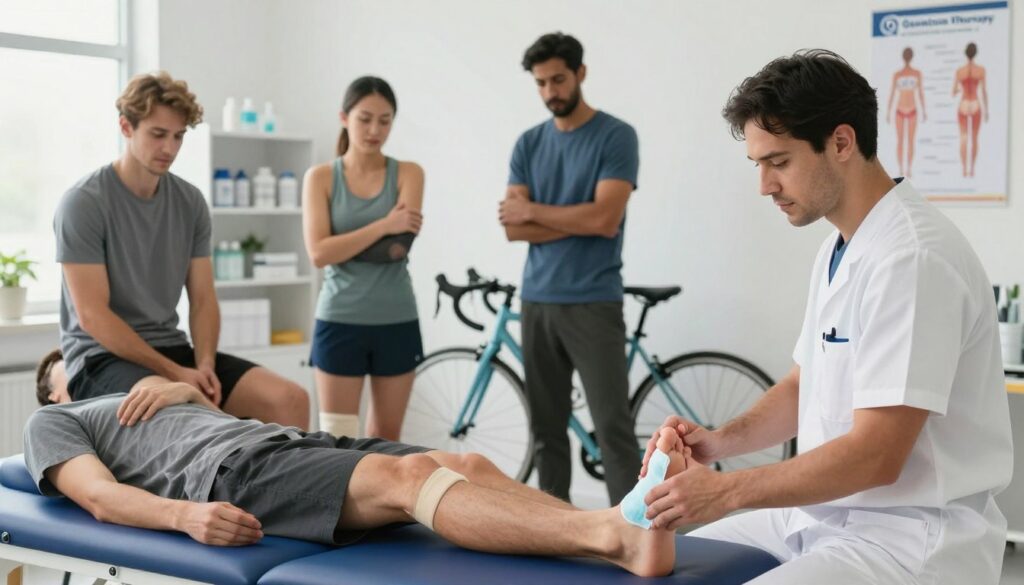
Sprains, strains and tendon overload
These problems often follow training spikes, poor recovery or weak hip and ankle control. Pain and reduced tolerance make everyday drills risky.
Targeted rehab rebuilds tissue capacity with graded loading, flexibility work and progressive strength to lower recurrence.
Ligament and joint stability issues
Ligament tears and joint laxity cause giving-way episodes and limit cutting or jumping. Neuromuscular retraining restores control.
Progressive loading and sport-specific drills rebuild confidence, improve function and protect joints during direction changes.
Fracture and post-immobilisation rehabilitation
After a cast or brace, patients commonly face stiffness, strength loss and proprioception gaps. Early graded mobility is essential.
Care focuses on restoring range, calibrated strengthening and balance work to return safe movement and everyday function.
Post-surgery rehabilitation for a safe return to sport
Surgical recovery follows staged goals: pain and swelling control, restored mobility, then strength and sport drills.
We use objective criteria and individualised plans so patients progress only when readiness and movement quality are proven.
Physiotherapy assessment and personalised treatment plans
We begin by building a complete picture of your injury, lifestyle and training demands. The opening session sets a clear baseline so the team can design realistic goals and safe steps for recovery.
Detailed evaluation of injury history, training load and biomechanics
The first visit includes focused history taking: how the injury happened, past problems and symptom behaviour. We screen relevant joints and tissues to identify pain drivers.
Training-load checks look for sudden volume or intensity spikes, footwear, surface issues and recovery habits that may prolong symptoms.
Biomechanics are tested with simple movements — squats, lunges, single-leg hops, landing control, shoulder checks or a running gait review depending on sport.
Goal-based planning aligned with your sport, timeline and unique needs
Treatment plans are built around match dates, work demands and the patient’s unique needs. Plans respect tissue healing and avoid rushing return-to-play.
Shared decision-making keeps the patient involved. Where needed, KD Hospital and Holy Spirit Hospital coordinate with physicians and surgeons so the plan matches the clinical condition.
Progress monitoring and plan adjustments through rehabilitation
Progress is tracked using objective techniques: range, strength and balance tests, hop protocols and performance markers. Pain response and functional measures guide adjustments.
Regular reviews ensure treatment plans stay relevant, helping patients return safely and confidently to training and sport-specific activity.
Physiotherapy treatments we use to reduce pain and restore mobility
A mix of manual approaches and therapeutic equipment helps reduce pain and rebuild function quickly. Our aim is to pair targeted hands-on care with modalities that enable safer, more effective exercise progressions.

Manual therapy techniques for pain relief and joint mobility
Manual therapy is used to ease pain, restore joint mobility and normalise soft-tissue tension. Techniques are brief and specific, then combined with active rehab to make gains durable.
Electrotherapy and stimulation options
Electrotherapy provides short-term pain modulation to allow better movement quality. When clinically indicated, devices also create a supportive environment for tissue healing.
TENS (transcutaneous electrical nerve stimulation) is a non-invasive option for pain control. This differs from electrical stimulation used selectively to assist muscle activation during retraining.
Ultrasound, heat and other evidence-based modalities
Ultrasound uses high-frequency sound waves to support healing and reduce pain as part of an evidence-based plan—not a standalone cure. Heat therapies (hydrocollator packs, shortwave diathermy where available) ease stiffness and boost circulation before exercise.
Traction, decompression and advanced equipment
Traction and decompression are used selectively for certain spine-related symptoms after careful assessment. Balance trainers, graded treadmills and other advanced equipment enable controlled movement retraining and improve confidence for sport.
- Key advantage: Techniques are assessment-led and always paired with active treatment plans.
- Available equipment: TENS, IFC, ultrasound, traction units and balance trainers support personalised recovery.
Exercise therapy and rehabilitation: rebuilding strength, control and confidence
Restoring safe, strong movement requires progressive work tailored to tissue healing and sport demands. Early stages focus on protection, symptom control and preserving function with low-load exercises.
Early-stage priorities
Protect the injured area and reduce irritability with controlled mobilisation. Use isometrics and gentle range work to prevent deconditioning.
Maintain safe movement patterns through guided drills that avoid painful positions while keeping the rest of the body active.
Strength and conditioning progressions
Progress from isometric holds to isotonic loading, then add eccentric work for tendon health. Power development is introduced later and aligned to sport-specific demands.
Mobility, drills and return-to-play
Restore joint range and muscle flexibility—examples include ankle dorsiflexion, hip rotation and thoracic mobility exercises. Sport drills (acceleration, change-of-direction, plyometrics or throwing) are introduced when criteria are met.
Return-to-play is staged and measurable, using functional tests and symptom response rather than time alone.
| Stage | Focus | Typical tools | Goal |
|---|---|---|---|
| Early | Protect & maintain | Isometrics, CPM, bike | Reduce pain, preserve range |
| Rebuild | Strength & control | Multi‑station gym, Swiss ball | Restore strength, movement |
| Sport-specific | Power & skill | Treadmill, wobble board, plyo drills | Safe return to training |
Training guidance
Manage load with planned weekly progressions, rest days and attention to sleep and nutrition. Avoid sudden spikes in training that commonly trigger relapse.
Preventing sports injuries: practical tips from our physiotherapists
Smart preparation before activity and sensible recovery afterwards preserve tissue capacity.

Warm-ups, cool-downs and technique correction to protect joints
Begin each session with a pulse-raiser and dynamic mobility to prime joints and muscles.
Activate key stabilisers—glutes, scapular retractors and core—before heavy loading. Add sport-specific rehearsal to rehearse the exact movement pattern.
Technique cues—landing softly, tracking the knees over toes, maintaining lifting spine alignment and a slightly higher running cadence—reduce common pain triggers.
Recovery habits that improve quality of life and performance
Plan the 24–48 hours after hard training: down-regulation, gentle mobility and sleep-focused routines help tissue repair.
Consistent sleep, good hydration and sensible weekly programming raise performance and quality life. Rest strategies during busy periods prevent overload.
Posture, ergonomics and self-management strategies between sessions
Desk-based athletes should adjust chair height, use lumbar support and change position every 30–45 minutes to protect mobility and reduce stiffness.
Self-management means spotting early warning signs, modifying training to match needs and seeking timely care rather than pushing through persistent symptoms.
- Warm-up: pulse-raiser, dynamic mobility, activation, sport rehearsal.
- Cool-down: gentle mobility, breathing, plan rest and nutrition for 48 hours.
- Technique: landing, knee tracking, cadence, lifting form, shoulder position.
- Recovery: sleep, hydration, programmed rest, stress-aware choices.
Why choose our physiotherapy department for sports injury care
Patients benefit when expert clinicians work with surgeons and coaches to create practical recovery plans.
Experienced clinicians and multidisciplinary collaboration
Our physiotherapists bring years of sports-specific experience and evidence-based techniques to every case.
They work closely with orthopaedic surgeons, radiologists and the wider team when imaging or post‑operative advice is needed.
State-of-the-art facilities and equipment
Both hospitals offer modern treatment options, including ultrasound therapy, traction systems and balance trainers.
Advanced exercise tools support staged rehabilitation and measurable progress.
Patient-centred care that builds independence
Quality care means clear education, shared goals and transparent timelines.
We focus on empowering patients to self-manage flare-ups and sustain long-term resilience.
- Safe, tailored treatment: plans match sport demands and risk factors.
- Structured progress: reassessments and criteria guide return-to-play.
- Compassionate services: personalised support across recovery stages.
Conclusion
True improvement follows a structured plan: assess, reduce pain, rebuild strength and rehearse sport skills. This blend of focused assessment and targeted therapy gives the best chance of reliable recovery.
Holy Spirit Hospital frames rehabilitation as empowering lives; KD Hospital emphasises personalised plans and ongoing support. Together these services aim for safer movement, restored strength and fewer relapses — not quick fixes.
If pain persists or flare-ups repeat, act early. Book an assessment to clarify diagnosis, set realistic timelines and start a tailored plan aligned to your sport demands.
High-quality care prioritises independence, confidence and long-term performance so you return stronger and stay active for life.