

Effective injury management for Indian workplaces is a practical, repeatable approach that starts the moment an incident occurs and carries through to a safe return to work.
This guide sets clear expectations: a straightforward, step-by-step approach businesses can use across offices, factories, warehouses, construction sites and field roles without adding day-to-day complexity.
Treating the response as a management discipline, rather than mere compliance, helps protect health, cut disruption and strengthen workplace safety culture.
We will cover core phases: immediate response and triage, documentation and reporting, incident investigation, corrective actions, rehabilitation planning, and structured return-to-work.
Readers — employers, HR, EHS teams, site managers and supervisors — will gain practical protocols they can train teams on, and simple ways to measure progress with leading and lagging indicators.
Consistency matters: when every case follows the same process, businesses reduce disputes, avoid missed details and build trust among staff. The final section moves from response into prevention to help limit repeat events and long-term costs.
Key Takeaways
- Define a simple, repeatable process that begins at the point of an incident.
- Focus on practical steps and decision points, not vague policy language.
- Use consistent protocols across sites to reduce disputes and missed steps.
- Train teams and track progress with clear indicators.
- Plan for rehabilitation and a structured return to work to speed safe recovery.
Why workplace injuries demand a structured approach in Indian businesses
A single workplace event can cascade into lost shifts, disrupted production and strained teams unless handled with a clear, repeatable process.
In India, multi-shift operations, contractor-heavy sites and high throughput make that cascade more likely. One absent operator can create bottlenecks, force overtime, raise supervisor workload and push back delivery timelines.
How downtime affects productivity, morale and continuity
The downtime chain reaction is simple and fast: a trained worker is removed from work, nearby tasks slow, quality suffers and others work longer to meet targets. Slow or confused responses damage trust.
When employees see poor handling—delays, blame or inconsistent steps—they hide early symptoms and team morale drops. Lower reporting raises the risk of repeat events and longer absences.
Understanding direct and indirect costs
Direct cost covers medical care, medicines and physiotherapy. Indirect costs include lost output, replacement labour, retraining, quality defects, equipment damage and administrative time.
“Indirect costs can be many times higher than direct medical bills—sometimes up to ten times.”
Financial leaders should treat prevention and early return as commercial priorities. Consistent protocols protect business continuity, reduce disputes and help retain experienced staff.
The solution is a clear framework that assigns roles, decisions and timelines from incident to recovery so small events do not become large problems for the business.
Build an injury management framework that fits your workplace
A practical framework sets out exactly who acts, when and how, so teams can focus on care and continuity.
What the framework covers: reporting, rehabilitation and the planned return to work are handled as linked steps. The aim is clear: prompt reporting, organised care, coordinated recovery and a safe return with suitable duties.

Roles and responsibilities
Managers ensure immediate safety and start the process. Employees report early and follow agreed steps. Safety teams support investigation and corrective actions.
Designing an adaptable plan
A good plan is dynamic. Different conditions and roles need tailored restrictions, follow-ups and communication schedules.
Post‑incident protocols and training
Define who to call, where forms are stored, transport arrangements and who authorises care. Use short, recurring refresher sessions for supervisors and first responders on rotating shifts.
“Combine prevention programmes with return‑to‑work options to lower disruption and speed recovery.”
| Element | What it does | Who owns it |
|---|---|---|
| Reporting process | Captures facts quickly and triggers care | Supervisor / Employee |
| Rehabilitation plan | Supports recovery and staged return | HR / Treating clinician |
| Return-to-work options | Provides suitable duties and timelines | HR / Line manager |
| Training & audits | Keeps protocols familiar and reliable | Safety team |
Operational tone: the framework should remove friction when decisions matter. Build stakeholder coordination from day one—clinicians, insurers, unions and contractors—to avoid delays and disputes.
Respond immediately after a workplace injury to protect health and limit complications
Early, calm action at the scene sets the tone for care, cost control and trust across the site.

Making the area safe and supporting the injured employee
First-minute priorities are clear: stop work, isolate energy, control traffic and prevent secondary incidents.
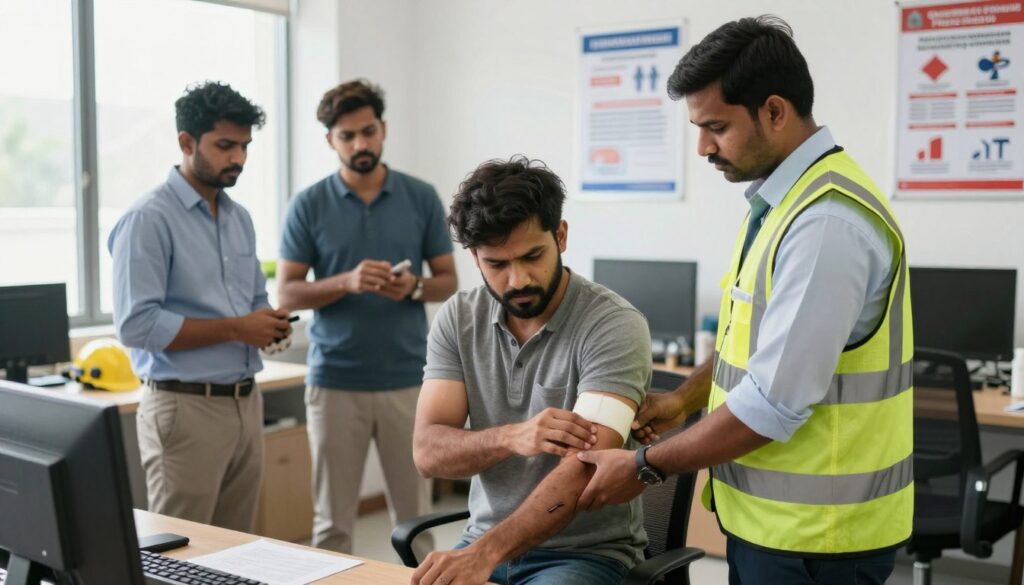
Supervisors should offer calm reassurance, arrange privacy where possible and organise first aid or transport.
Using onsite clinics or nurse triage lines for fast assessment
Rapid assessment, even for minor cuts or burns, reduces complications and shortens recovery.
Onsite clinics or nurse lines can assess severity, guide first aid and direct the case to the right services.
Choosing the right level of care and avoiding unnecessary costs
Decision rules help avoid needless emergency visits: use emergency care for life‑threatening problems; urgent care or primary care for non-critical needs.
| Situation | Recommended care | Who documents |
|---|---|---|
| Life‑threatening signs | Emergency department | Supervisor / First aider |
| Moderate bleeding, suspected fracture | Urgent care / clinic | Onsite clinic or nurse line |
| Minor cuts, burns | Onsite first aid / clinic | Supervisor |
Building trust through fast, respectful communication
Within 24 hours, inform HR and site leadership and, where appropriate, the employee’s family. Keep messages factual and respectful.
Consistent, professional responses make employees more likely to report early. Trust grows from actions—speed, empathy and a reliable process.
Document and report workplace injuries accurately to keep the process on track
A prompt, factual record is the foundation for fair outcomes and faster service coordination. Capture facts while they are fresh so treatment, insurer contact and return planning are not delayed.
Capturing critical details quickly: photos, measurements and witness statements
Record time, location, task underway, tools and environmental conditions immediately after the incident. Note the sequence of events in plain, factual language.
Evidence standards: take clear photos from multiple angles, measure heights and gaps, and secure machine settings where it is safe to do so.
Including the injured worker’s account to uncover additional insights
The injured worker’s perspective often reveals near misses, root causes or other witnesses. Treat this account as a core input rather than an afterthought.
Collect statements separately. Use factual prompts and avoid leading questions to keep records robust.
Maintaining compliant records to streamline reporting and reduce dispute risk
Use a simple reporting workflow: initial notification by the supervisor, a detailed report by the safety lead, and a review within set timelines. Keep access controlled and templates consistent.
“Clear records reduce delays, lower costs and make later analysis reliable.”
| Item | What to capture | Owner |
|---|---|---|
| Immediate facts | Time, place, task, witnesses | Supervisor |
| Evidence | Photos, measurements, equipment settings | Safety lead |
| Records | Secure storage, access logs, templates | HR / Records team |
Good documentation cuts costs by speeding clinical decisions, insurer liaison and return-to-work planning. It also turns incidents into learning that prevents repeats.
Investigate incidents to find root causes and prevent repeat injuries
A focused investigation uncovers why a task went wrong and prevents the same problem repeating. Start with a clear, proportionate process so findings lead to meaningful prevention.
Running a practical fact‑finding workflow
Secure the area, preserve evidence and gather witness statements without delay.
Review CCTV if available, map the sequence of events and separate immediate causes from underlying ones.
Roles that keep the enquiry fair and useful
Supervisors lead fact‑finding. Safety leads check method and quality. Workers provide task detail to avoid unrealistic conclusions.
Common contributors to test systematically
- Equipment failure or bypassed guards
- Maintenance backlog or poor machine checks
- Inadequate induction or training gaps
- Fatigue, workload pressure and unclear procedures
Corrective actions and controls
Follow a hierarchy: engineering fixes first, then procedure updates, targeted training and verification that changes stick.
Use job hazard assessments to break tasks into steps and apply engineering controls, administrative controls and PPE as required.
“Investigations must move past ‘operator error’ to address design, supervision and maintenance failures.”
| Activity | Purpose | Owner |
|---|---|---|
| Scene preservation | Keep evidence intact for accurate analysis | Supervisor |
| Sequence mapping | Show what happened and why at each step | Safety lead |
| Corrective plan | Apply fixes in priority order and verify | Line manager / HR |
Use trend analysis of repeated events to target prevention budgets and strengthen programs like I2P2. That turns individual findings into broader workplace improvements and reduces future risk.
Enable recovery and return to work with suitable duties and coordinated care
A planned, supported return preserves capacity and speeds recovery for both the employee and the team.
Why early, safe return improves outcomes
Safe activity aids recovery by keeping employees active, reducing isolation and maintaining routine.
Early return lowers the chance that absence becomes long term and reduces indirect costs for employers.
Designing a personalised return-to-work plan
Align medical guidance with real job demands and document restrictions clearly—lifting limits, standing tolerance and repetitive motion limits.
Set review dates and record who owns each step so progress is tracked and the plan adapts as the worker recovers.
Transitional duties and task banks that add value
Create a written bank of suitable duties that genuinely help operations: inventory checks, quality audits, tool control, training support and documentation updates.
Write simple job and transitional-duty descriptions so supervisors can match tasks to restrictions quickly and consistently.
Preferred providers and two-way communication
Choose clinicians and providers who understand industrial demands and invite them to review job tasks.
Keep open communication with treating physicians: share clear job demands, request functional capacity guidance and update them after follow-ups.
When to use case managers and rehabilitation professionals
Escalate to case managers or rehab professionals for complex cases, slow recovery, multiple stakeholders or psychosocial risk factors.
These professionals coordinate services, monitor progress and help align duties with capability to protect health and business continuity.
“Return programmes succeed when they balance practical business needs with respectful, staged support for employees.”
Make injury prevention and safety culture part of everyday work
Embedding safe habits into daily routines turns hazard spotting from a one‑off task into a shared workplace duty.
Make prevention-led injury management routine by adding short toolbox talks, supervisor walkarounds and job hazard assessment refreshers to each shift.
Encourage near‑miss and hazard reporting without blame. Clear, timely communication on what was found and what will be fixed strengthens trust and ownership.
Use incident data to focus resources: spot patterns, prioritise controls and check whether actions actually reduce risk over time.
Leadership matters: recognise proactive reporting, align contractors to the same standards and keep safety visible alongside production metrics.
Small, consistent steps cut costs, protect workers and make a safety culture part of everyday work.