
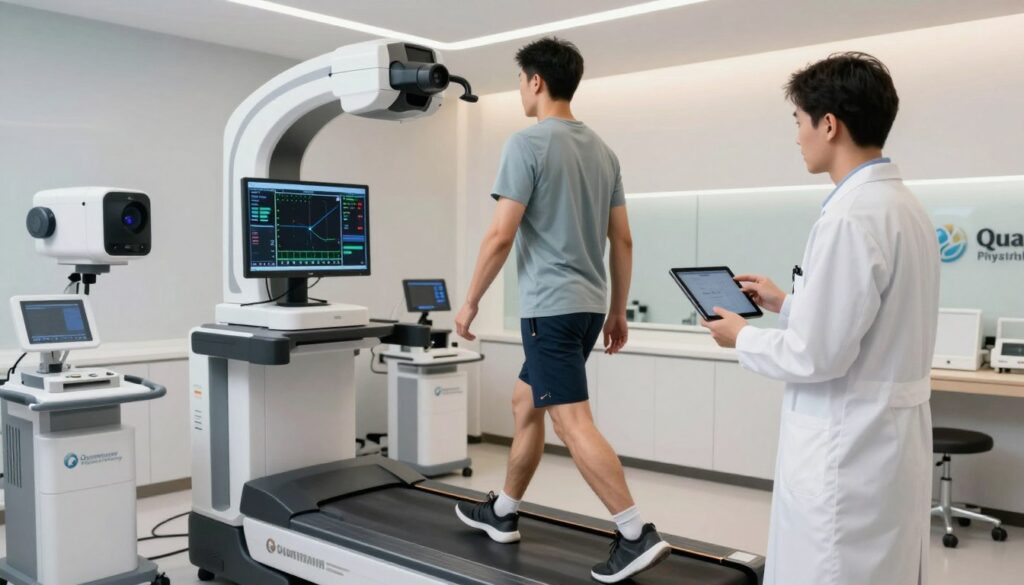
Comprehensive gait analysis services in India mean a structured, repeatable process that turns observation and measurements into a reliable diagnostic aid rather than guesswork.
Clinics combine short captures on a treadmill or walkway with frame-by-frame replay and key metrics. Retail-style running assessments often last around thirty minutes, with a ten to fifteen second recording in neutral shoes.
The guide explains what this service is, what clinicians look for, the data and methods used, and how findings form a care plan. It also covers optional add-ons such as side-view capture and 3D foot scanning that create a rapid 3D model and measurements.
This section is for patients, runners, clinicians and physiotherapists. It highlights common injuries and recurring issues that prompt referral, and stresses that one clear snapshot helps, but repeatability and multiple cycles build confidence.
After reading, you will ask better questions, value objective data, and see how rehab, orthotics and footwear changes are derived.
Key Takeaways
- Structured process: an organised, repeatable service supports accurate diagnosis.
- Efficient format: short capture times with detailed replay save patient time.
- Tools matter: 3D scans and side views add practical, objective data.
- Who benefits: patients, runners, clinicians and physiotherapists gain clearer care plans.
- Repeatability: multiple cycles increase confidence in results.
What gait analysis is and why it matters for accurate diagnosis
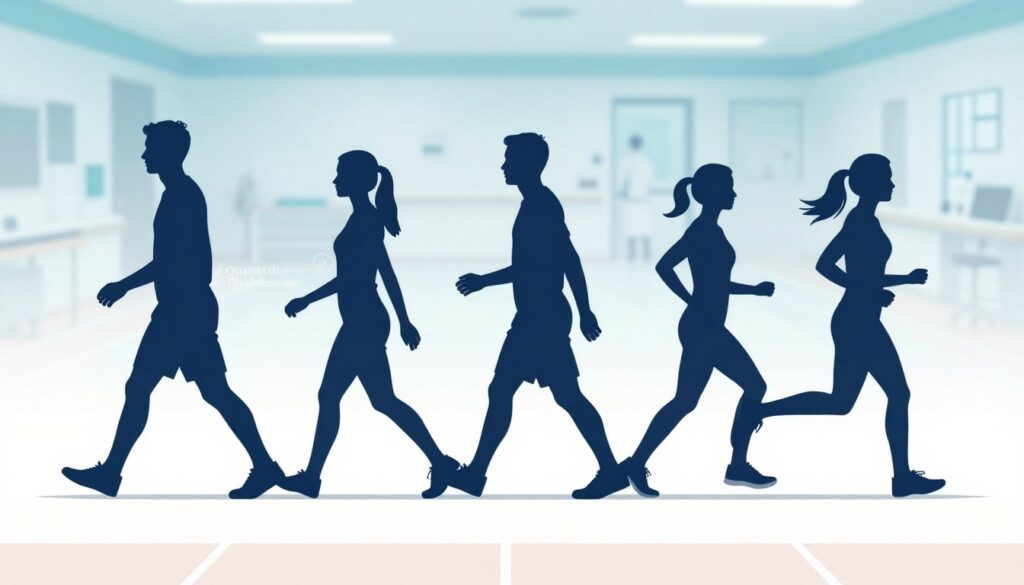
Normal locomotion is not just how someone looks while moving; it is a repeatable, energy-efficient strategy the body uses to manage load.
The term describes rhythmic, alternating lower-limb movement that produces forward progression with minimal energy use. This understanding helps clinicians judge efficiency, not appearance alone.
How evaluation reveals hidden drivers
Evaluation highlights compensations that often hide the true source of pain. Left-right differences, altered timing and unusual joint motion can point to prior injuries or pathology.
“A single snapshot can mislead; repeated cycles reveal patterns that guide treatment.”
When cycle-based review is most useful
Cycle observation is valuable for patients with ongoing pain, post-surgery follow-up, neurological conditions, and return-to-sport decisions.
- Clinical use: diagnosis, rehab planning and tracking progress.
- Research use: testing interventions, footwear or assistive devices.
- Practical note for India: busy clinics gain the best results by pairing focused observation with selective objective measures for speed and cost-effectiveness.
Limitations: parameters do not predict every injury, but they document how a patient moves now and how that changes with treatment.
Gait cycle essentials clinicians assess during a gait analysis
Most clinical problems surface when the foot meets the ground and the body accepts weight in the stance phase. The movement cycle splits into two broad parts: stance (about 60%) and swing (about 40%). Clinicians watch the stance phase closely because loading exposes deficits not obvious when the limb swings.
Stance versus swing and why loading matters
Loading means weight acceptance and shock absorption after contact with the ground. Poor control here can cause compensations later in the cycle and produce pain or inefficiency.
Support periods that affect stability
Support is the time a limb bears weight. Single support is when one limb holds the body; double support is when both feet touch ground. Longer double support or shortened single support often signals pain avoidance or reduced stability.
Stance sub-phases clinicians inspect
- Contact: initial foot contact and force direction into the limb.
- Foot-flat (loading response): shock absorption and rapid transition.
- Mid-stance: body passes over the foot; balance and alignment are key.
- Propulsive phase: heel rise and toe-off generate forward drive.
Clinicians use slow-motion replay to note cues: timing of contact, speed of foot-flat, centre-of-mass progression in mid-stance, and quality of propulsion. These observations guide where to look first when a patient reports pain or recurring performance issues.
What data is collected during gait assessment and how to interpret it
Assessment captures spatial, force and muscle data to explain why symptoms occur.
Three pillars of measurement: kinematics show what moves; kinetics show what forces act; EMG shows which muscles fire and when. Together they turn numbers into clinical insight.
Kinematic and spatio-temporal information
Key metrics: step length, stride length, step width and foot angle (relative to the line of progression). Shorter step length or a wider step often reflects pain, reduced confidence or a balance strategy. Compare left versus right and across trials.
Kinetic information
Gravity and interaction produce vertical ground reaction force and plantar pressure maps. Pressure distribution reveals where the foot bears load. Centre of pressure pathways help localise overload and risky loading patterns.
Muscle activation (EMG)
EMG indicates whether muscles activate at the correct phase and duration. It supports diagnosis but needs careful setup; skin artefact and noise can limit quality.
| Metric | What it measures | Clinical meaning | Action |
|---|---|---|---|
| Step length | Distance between consecutive contacts | Asymmetry suggests pain or weakness | Compare sides; repeat trials |
| Vertical force | Load during stance | High peaks may indicate abrupt loading | Review footwear and shock absorption |
| Centre of pressure | Path of load under the sole | Shifted path points to overload site | Targeted offloading or orthotic change |
| EMG timing | Muscle onset/offset across phases | Early or late firing can impair function | Rehab to retrain timing |
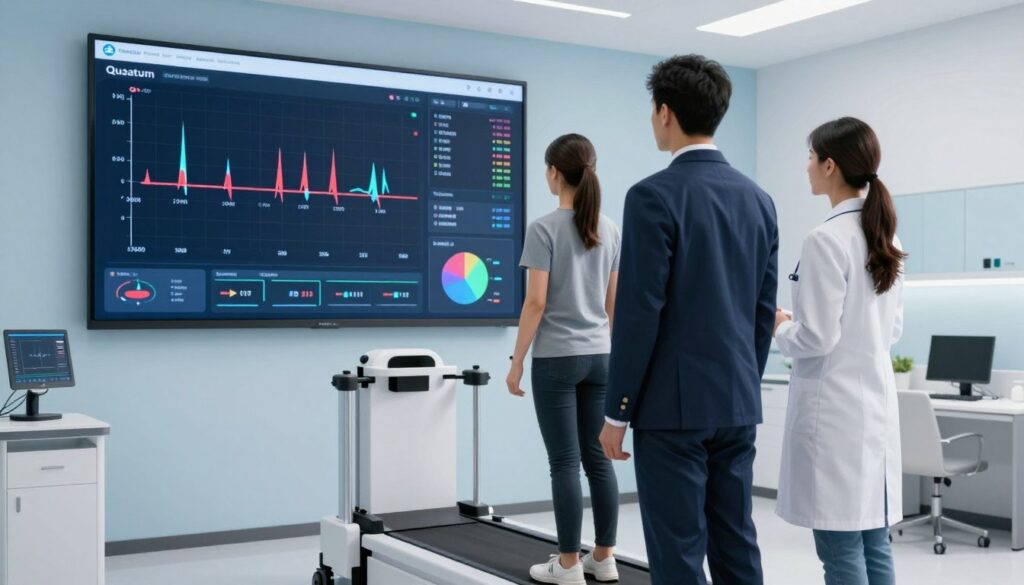
One complete gait cycle is the minimum unit: observed leg strike → contralateral strike → observed leg strike. Use multiple foot strikes to reduce the risk of over-interpreting a single atypical stride and relate findings to the patient’s weight-bearing tolerance and training load.
Methods and technology used in modern gait analysis services
Modern clinics use a layered toolkit that starts with simple observation and moves to instrumented platforms and 3D labs. Choice depends on the clinical question, space and budget.
Qualitative approaches clinicians use
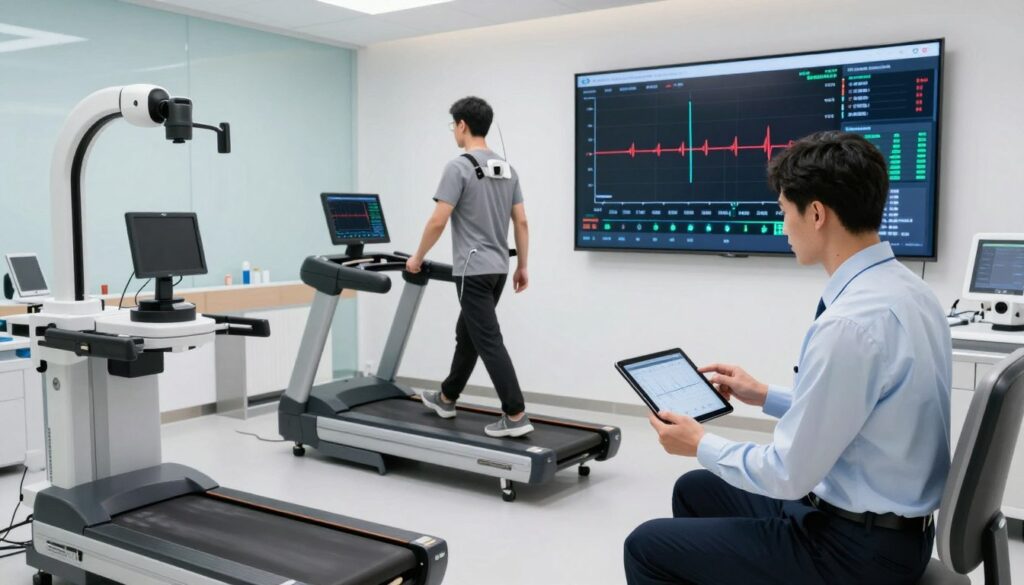
Visual observation and slow-motion video replay catch obvious asymmetry and timing faults. Functional scales (Timed Up and Go, 6-minute walk) provide repeatable scores for progress.
2D marker video versus 3D lab systems
2D video is cost-effective and quick but misses out-of-plane rotations. 3D systems capture detailed motion and joint rotation but need space, calibration and specialist operation.
Force, pressure and platform tools
Force plates report magnitude and direction of ground reaction force and centre-of-pressure. Pressure platforms and continuous walkways map distribution under the feet across multiple steps.
In-shoe systems and wearables
In-shoe plantar pressure sensors measure loading inside real footwear and help with orthoses and return-to-run choices. IMUs record acceleration and angular velocity for outside-the-lab monitoring but need careful placement to avoid artefact.
Practical decision framework for India
Start with observation + video for most patients. Add a pressure platform or in-shoe system when footwear or load distribution is central. Reserve 3D labs for complex cases where high accuracy justifies cost and set-up time.
How to prepare for and undergo a comprehensive gait analysis session
Preparing well makes the test quicker and the findings more useful for practical care. A short intake gives the clinician context so the session focuses on your goals and symptoms.
Before your appointment
Bring the shoes you train in and a neutral pair for testing. Wear close-fitting shorts so the clinician can see leg movement clearly.
Note when pain occurs, especially during the stance phase or at initial contact. Record recent training, events and past injuries.
What happens during the test
Expect a ~30-minute appointment with a 10–15 second treadmill capture in a neutral shoe. Multiple foot strikes are recorded to improve representativeness.
Clinicians use slow-motion video and frame-by-frame replay to view early loading and propulsion in each cycle.
Review and optional add-ons
Results are shown as clear metrics and plain-language notes so the patient understands next steps.
Optional enhancements include plantar pressure maps and a 3D foot scan for sizing and targeted offloading advice.
| Stage | Purpose | Patient action |
|---|---|---|
| Intake | Gather history and goals | Bring shoes; list symptoms |
| Capture | Record movement cycles on treadmill | Wear neutral shoes during test |
| Review | Explain key metrics and plan | Ask questions; agree follow-up |
Leave with a summary, clear next steps and a plan for follow-up or re-testing at an agreed time.
Turning results into a clear care plan and better movement outcomes
Translate measured findings into a simple, ordered care plan: prioritise the biggest pain drivers, load‑tolerance limits and control deficits, then match interventions to the highest‑impact items.
If problems concentrate in early stance phase, target load acceptance, progressive strength and technique. When propulsion is weak, focus on calf capacity, foot mechanics and cadence changes.
Common components used in India include physiotherapy programmes, mobility and strength progressions, running retraining, footwear adjustments and timely referrals for complex injuries.
Use normal gait reference ranges as a comparison tool, not a strict template. Re-testing with the same methods documents change, validates treatment and helps prevent recurrence.
Practical next steps: explain results in plain language, agree a follow‑up (6–12 weeks), and monitor key symptoms or metrics between visits so the plan can be adjusted quickly.
FAQ
What is gait analysis and why does it matter for accurate diagnosis?
A comprehensive movement assessment studies how a person walks or runs to identify asymmetries, inefficiencies and patterns linked to pain or injury. Clinicians use these findings to pinpoint sources of dysfunction, guide treatment choices such as orthotics or physiotherapy, and monitor recovery over time.
How is forward movement defined in clinical terms?
Efficient forward movement involves coordinated motion of the feet, ankles, knees, hips and trunk that conserves energy. Clinicians look for smooth step transitions, balanced weight transfer and consistent timing to judge efficiency and detect deviations that suggest underlying problems.
When is cycle evaluation most useful in clinical and research settings?
Cycle evaluation helps in cases of persistent pain, unexplained limping, post-surgical follow-up, athletic performance tuning and neurological disorders. It is also essential for research into footwear, rehabilitation strategies and injury prevention, where objective measures are required.
Which parts of the walking cycle do clinicians focus on during an assessment?
Assessors concentrate on the stance and swing phases, with particular attention to loading during stance when most problems appear. They also observe single-support and double-support periods to evaluate balance and stability throughout each step.
What stance sub-phases are important to observe in detail?
Key sub-phases include initial contact, foot-flat, mid-stance and propulsion. Each reveals different mechanical demands — for example, initial contact shows shock absorption while propulsion highlights push-off mechanics and calf function.
What kinematic and spatio-temporal data are collected and why?
Common measures include step length, stride length, step width, cadence and foot angle. These variables quantify movement patterns, symmetry and timing, helping clinicians detect reduced range, asymmetry or compensatory strategies that may need intervention.
What kinetic information is recorded during an assessment?
Force-related data include ground reaction forces, pressure distribution across the sole and the centre of pressure/force trajectory. These metrics show how load is applied and transferred, revealing areas of overload or atypical loading that could cause pain.
How does muscle activation data contribute to diagnosis?
Electromyography (EMG) captures when and how strongly muscles fire across the cycle. This reveals timing errors, delayed activation or excessive co-contraction that explain inefficient motion and inform targeted rehabilitation.
How many steps are needed for a reliable picture?
One complete cycle is the minimum, but multiple steps improve reliability and reduce the effect of an atypical stride. Clinicians often collect several trials to compute averages and ensure a consistent assessment of movement patterns.
What qualitative methods are used in clinics?
Visual observation, structured gait scales and video replay remain valuable for rapid screening and clinician-led interpretation. These qualitative tools help identify obvious deviations before quantitative testing refines the diagnosis.
What kinematic options exist for quantitative testing?
Simple 2D marker-based video analysis suits many clinics for sagittal-plane assessment, while 3D laboratory systems provide full three-dimensional joint kinematics for complex cases requiring high precision.
Which force and pressure tools are commonly used?
Force plates, pressure platforms and continuous pressure-mapping walkways measure how the feet load the ground. These systems detect asymmetry in load, peak pressures and the centre of pressure path during stance.
When are in-shoe pressure systems recommended?
In-shoe plantar pressure sensors are ideal when footwear and real-world loading matter, such as assessing orthoses, diabetic foot risk or activity-specific mechanics outside the lab environment.
How do wearables and IMUs add value to testing?
Inertial measurement units (IMUs) allow measurement of motion outside the clinic, enabling long-term monitoring of steps, cadence and limb angles in natural settings. They are useful for remote assessment and tracking progress during daily activities.
How should clinics balance cost, space and accuracy when choosing equipment?
Clinics should match tools to clinical needs: low-cost video and pressure mats suit routine assessments, while 3D labs and multiple force plates fit specialised centres. Consider patient volume, space, staff training and desired level of diagnostic detail.
How should a patient prepare for a comprehensive assessment?
Patients should provide injury history and typical footwear, wear comfortable shorts or loose clothing, and avoid heavy lotions that affect sensors. Clinicians will also review activity habits and goals during the intake to tailor the protocol.
What happens during the test itself?
The session typically involves walking on a treadmill or across a walkway while cameras, force plates or sensors capture multiple foot strikes. Examiners may repeat trials at different speeds or with and without footwear to compare mechanics.
How are results reviewed with the patient?
Results are shown using slow-motion or frame-by-frame video alongside key metrics such as step symmetry, pressure maps and force curves. Clinicians explain findings in plain language and discuss practical treatment options and goals.
What optional add-ons strengthen diagnosis?
Plantar pressure mapping, detailed foot measurement or 3D foot scans provide extra detail for orthotic design, diabetic foot care and footwear prescription. These add-ons improve the precision of interventions and outcome tracking.
How are assessment results turned into a care plan?
Clinicians integrate objective data with clinical examination to propose targeted interventions — for example, physiotherapy, gait retraining, orthoses, footwear advice or referral to podiatry. Follow-up testing monitors progress and refines the plan.