
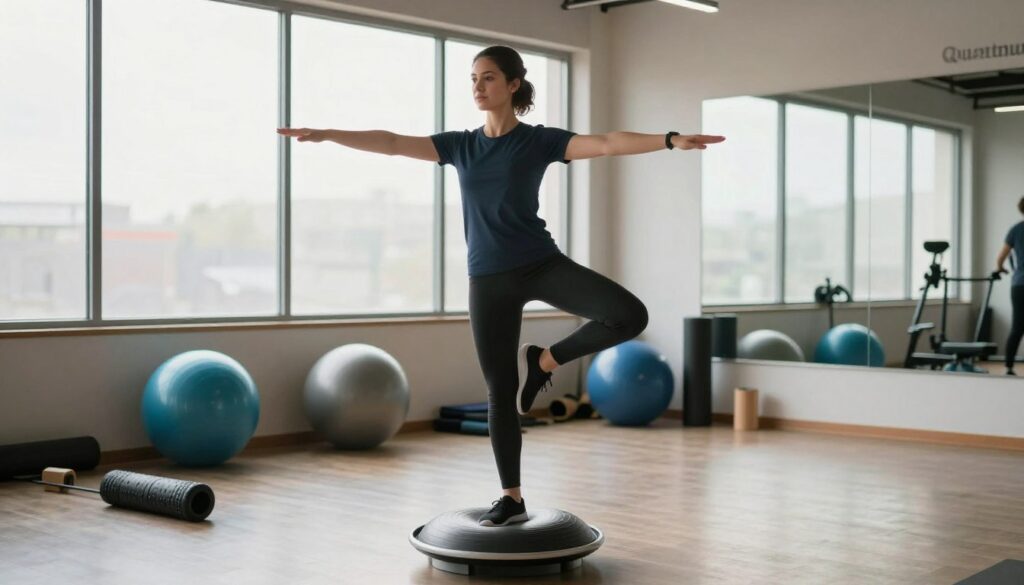
Balance training helps you control your body when your centre of gravity shifts during everyday movement.
This short guide is tailored for readers in India who want a home-friendly, equipment-light approach. It prioritises safety, regular practise and measurable progress.
Practising simple drills can boost your stability and coordination. UK guidance suggests older adults do such work at least twice a week, and a 2022 BMJ study links inability to stand on one foot for 10 seconds with a higher risk of death over ten years — an association that underlines why this matters.
The article will explain what balance is (static, dynamic and proprioception), how to set up safely, a twice-weekly routine, sensible progressions and how strength and core work improve real-world control.
Start supported, master control, then reduce assistance and add challenge. The goal is practical: steadier walking, safer stairs, fewer stumbles and more confidence carrying bags or moving in crowds.
Key Takeaways
- Simple, regular practice at home can significantly improve balance and reduce fall risk.
- Focus on stability, coordination and proprioception with twice-weekly sessions.
- UK guidance and a BMJ finding highlight the health relevance of one-leg capacity.
- Start with support, progress safely, and add strength work for lasting gains.
- Outcomes include steadier walking, safer stairs and greater everyday confidence.
Why improving your balance matters for everyday movement and long-term health</h2>
Good postural control makes everyday tasks feel easier and safer, from stepping off a kerb to carrying shopping.

Better stability and coordination help with everyday activities, sport and safer mobility. Cutting, lunging or landing in sport relies on control through the foot, ankle, knee and hip. This reduces the chance of an acute injury by helping you react and reposition quickly.
Reduced falls risk with age
Control tends to decline as people grow older. Around 1 in 3 people aged 65+ have at least one fall each year (NHS figures). Preventive work lowers that risk and supports safer walking and stair use.
Who benefits most
Older adults, those recovering from stroke, people with peripheral neuropathy, and those with Parkinson’s often gain most from simple practice. Office workers and anyone returning to exercise also see practical gains in daily mobility.
| Group | Main issue | Practical benefit |
|---|---|---|
| Older adults | Reduced proprioception | Fewer falls, safer walking |
| Post-stroke | Impaired control | Improved walking and transfers |
| Peripheral neuropathy | Nerve loss in feet | Better foot awareness, less stubbing |
| Active people | Sport-related stumbles | Safer changes of direction |
Aim for twice-weekly sessions as a steady habit. Small, regular practice builds both capability and the confidence needed for real-world independence.
What balance is made of: static balance, dynamic balance and proprioception</h2>
Breaking down what keeps you upright clarifies which drills improve everyday movement. These three components together build the ability to stand, step and recover when you are pushed off line.
Static control: holding a steady position
Static control is the ability to keep a steady position. Examples include standing with your stand feet hip-width apart, pausing on one foot or staying upright when you stop moving.
Holding a single-leg position tests foot and ankle stability, and asks knee and hip muscles to work together to keep your body stacked over its base.
Dynamic control: staying upright while moving
Dynamic control is about movement. It covers controlled steps, smooth turns, safe stair climbing and standing up without wobbling as your centre of gravity shifts.
Good dynamic skill helps you walk confidently on uneven pavements or turn quickly without losing control.
Proprioception: sensing the body without looking
Proprioception is your body’s internal map that tells you where your joints are even with eyes closed. It speeds up reactions when you are nudged or step on an unexpected surface.
“Physiotherapy-led programmes challenge the vestibular and musculoskeletal systems to improve posture, reaction time and joint awareness.”
- Why this matters: Better static control supports safer dynamic movement.
- What exercises train: Not only the legs, but trunk muscles that keep your torso stacked over your base of support.
- Role of joints: A stable knee and foot help hold positions and move with control during daily gait patterns.
- Progression hint: Narrow the base of support, reduce visual feedback and reach outside your base to make real-world gains.
Set up your balance exercises safely at home</h2>
A clear, well-lit spot and a sturdy chair make practising easier and safer. Start by choosing a flat, hard floor near a wall or table so you can reach support quickly.

Practical checklist for a safe session
- Clear the floor of rugs and clutter.
- Use a flat hard surface rather than carpet or foam.
- Place a secure chair or stand by a wall within arm’s reach.
- Wear stable shoes or go barefoot if the surface is safe.
Why the chair and wall matter
Support reduces fear so your body learns the correct position and control. A chair lets you practise standing patterns without bracing or stiffening the back and hips.
Form cues and gaze strategy
Keep a tall posture, ribs stacked over the pelvis and distribute weight evenly through the feet. Pick one point at eye level and fix your gaze to reduce wobbling during single-leg work or heel-to-toe steps.
| Item | Benefit | When to use |
|---|---|---|
| Chair within reach | Immediate support to prevent falls | All standing exercises, beginners |
| Flat hard floor | Reliable feedback from feet | Preferred over carpet or foam |
| Fixed gaze point | Reduces sway and aids control | Single-leg or narrow-stance work |
Time your efforts in short, repeatable sets. Quality matters more than duration—stop if you feel chest pain, sudden dizziness or unusual breathlessness. If you have heart or circulatory conditions, diabetes or high blood pressure, speak to your doctor before starting new exercise.
balance training routine you can follow twice a week</h2>
Seven minutes, twice weekly, is enough to get measurable gains when you aim for controlled movement and steady progress.
Choose a level that fits where you are today: standing unaided, seated, or chair-supported. The goal is a clean, steady position rather than powering through wobble. Warm up with light marching for one minute, then cycle the ten exercises below and finish with gentle stretches.

How to choose your level
If you are new, use a chair for support or do the sequence seated. As you get confident, move to chair-supported standing, then to unaided standing. Keep a wall nearby for safety.
Single-leg stance
Start with stand feet hip-width apart, shift weight into the left foot and let the right foot hover. Hold position for 8–12 seconds, then repeat side.
Single-leg with a weight
Use a water bottle. Lift one leg and pass the weight hand-to-hand around the body. Keep hips level and core engaged. Use a chair in front if needed.
Heel digs
From tall posture, tap the front heel on the floor with a straight knee. Return to centre. Add arms at 45° to increase challenge while keeping the back tall.
Calf raises
Press through the balls of the feet and lift both heels. Hold the top for 8–12 seconds, then lower slowly. Progress by lifting one leg behind you while rising on the other.
Knee raises
Lift one knee as high as comfortable, look forward and lower slowly. Repeat to mimic marching mechanics. Speed up slightly to improve gait-like control.
Clock toe taps
Balance on the left foot and tap the right foot to front, side and behind about 30 cm. Keep taps quiet and the pelvis steady. Repeat direction and switch feet.
Heel-to-toe walk
Place the right heel to the left toes and step 5–10 times, shifting weight from heel to toes. Keep eyes forward and a wall nearby.
Side taps
Step out sideways then bring feet together for 5–10 controlled steps. Progress by taking larger steps to build lateral stability for real-life stumbles.
Four-point kneeling
On hands under shoulders and knees under hips, brace the core. Tap one arm forward or extend opposite arm and leg for full-body control. Use a towel under knees if needed.
| Option | When to use | Example progress |
|---|---|---|
| Seated | Low confidence or joint pain | Heel digs, knee raises, arm reaches |
| Chair-supported standing | Some balance but want safety | Single-leg hover, calf raises, clock taps |
| Unaided standing | Comfortable and steady | Single-leg holds 8–12s, heel-to-toe walk |
Session format: warm up 1 minute, ten exercises for the suggested seconds or repeats, cool down. Progress by adding arms, larger steps or small weights as control improves.
Progressions that make balance training more effective over time</h2>
Gradual challenge is the key: small, controlled increases make progress reliable and safe.
Start each session with a clear plan for one step at a time. Increase demand only when breathing stays steady and posture remains upright.
Reduce external support in stages
Begin with a firm grip on a chair. Move to a light touch, then fingertip hover and finally no contact.
Only advance when you control the position without panicking.
Increase time under control
Add a few extra seconds per set rather than big jumps. Holding positions for longer trains muscle reaction and joint sense.
Vary stance, surface and reach
Move from feet hip-width to narrower stances, then tandem and one-foot work. Try a folded towel or firm cushion only when safe.
Include reaching tasks and short bouts with eyes closed beside a support to improve body awareness for daily movement.
| Progression | Example | When to use |
|---|---|---|
| Support reduction | Firm grip → fingertip → none | As steady breathing and posture are maintained |
| Time increase | 8s → 10s → 12s holds | Add 2–3 seconds per week |
| Base & surface | Hip-width → tandem → single-foot; hard floor → towel | Only after consistent unaided control |
Add strength and core work to improve balance beyond “just balancing”</h2>
Combine targeted strength work with core drills to make upright control more reliable in daily life.
Why strength matters: Strong leg and trunk muscles improve your ability to control joint positions on stairs, while lunging, or when the ground is uneven. This reduces the chance of a tumble and lowers risk of long-term injury.
Single-leg strength moves that improve stability for stairs, lunges and uneven ground
Choose exercises that force one leg to do the work. Examples that scale well are step-ups (progress to a knee drive), supported single-leg Romanian deadlifts and single-leg squats to a chair.
Tip: Keep reps slow and stop before form breaks. Quality beats quantity for transfer to everyday movement.
Core anti-rotation work for steadier hips and shoulders during movement
Anti-rotation holds and dynamic core drills stop the hips and ribs from twisting when you carry a load or change direction.
Use plank shoulder taps, dead-bug variations and Pallof press-style holds for short, controlled sets.
Loaded carries to build real-world balance while walking with weight on one side
Suitcase carries and single-side walking with a shopping bag teach your body to brace and walk upright with a load.
Do 2–3 strength moves after your standing routine. Keep reps controlled, rest as needed and avoid pushing into pain.
“Stronger legs and a stable trunk make everyday tasks like stair climbing and carrying shopping safer and easier.”
| Focus | Example | Practical benefit |
|---|---|---|
| Single-leg strength | Step-ups → single-leg RDL | Better stair ascent and one-legged reactions |
| Lateral strength | Lateral lunge | Control for side-to-side slips in crowds or buses |
| Core anti-rotation | Pallof press, plank taps | Steadier hips and shoulders under load |
| Loaded carries | Suitcase carry | Walking with bags without leaning or wobble |
Make balance a habit you can rely on in real life</h2>
Slot two brief sessions into your week and anchor them to an existing routine — after a walk, before a shower or after morning tea. Keep each session short and focused so it fits daily life.
Use micro-practice during the day: a single-leg exercise while waiting for the kettle, or slow heel-to-toe steps along a corridor with a counter for support. These tiny moments add up.
Track one simple marker: seconds you hold each side, the number of controlled heel-to-toe steps, or how steady your foot feels on stairs. Rotate in enjoyable activities such as dancing or tai chi to keep motivation high.
Always keep a stable support within reach, avoid rushing and favour quality over intensity. Small, repeated practice plus basic strength work and steady progression builds real-world steadiness for everyday tasks.
FAQ
What parts of the body help me keep steady?
Your feet, ankles, legs, hips and core work together with sensory input from the eyes and inner ear. Strong muscles around the ankle and knee, good foot placement on the floor and reliable proprioception — the sense of where your body is — are all key to steady movement and posture.
How often should I practise these exercises to see improvement?
Aim for two focused sessions per week, with short daily activities like heel-to-toe walks or single-leg stands added in. Consistency matters: small, regular doses of work to the muscles and nervous system produce steady gains in stability and coordination.
Can I do these routines at home without special equipment?
Yes. Use a sturdy chair or wall for support and practise on a flat, hard floor. Simple items such as a small weight or a step can progress exercises, but many effective drills — single-leg stands, clock toe taps and heel digs — need no kit at all.
When should I see a doctor before starting?
Consult your GP or physiotherapist if you have heart or circulatory problems, recent falls, uncontrolled dizziness, significant joint pain or a neurological condition. They can confirm safety, advise on modifications and rule out underlying causes of instability.
What is the difference between static and dynamic work?
Static work means holding a steady position, for example standing on one foot. Dynamic work involves movement while staying upright — walking, turning, stepping up and reaching. Both types train different aspects of control and should be included in a routine.
How do I progress safely once exercises feel easier?
Reduce your hand support (from holding the chair to fingertip touch), increase hold times to several seconds, narrow your stance, change surface firmness or add reaching and head turns. Introduce light weights only when control remains steady.
Will strength and core exercises really help my stability?
Absolutely. Strong legs, hips and a resilient core improve the body’s ability to control weight shifts and recover from trips. Single-leg strength moves, anti-rotation core work and loaded carries translate directly to safer, more confident movement.
Are there simple daily habits that help maintain steadiness?
Yes. Wear supportive footwear, practise standing on one foot while brushing your teeth, slow down when changing direction, and include short walking drills like heel-to-toe steps. These habits reinforce muscle memory and reduce fall risk.
What common mistakes should I avoid when practising?
Avoid holding your breath, rushing through repetitions or progressing too quickly to unstable surfaces. Don’t over-rely on support; instead, reduce assistance gradually. Stop if a movement causes sharp pain or sudden dizziness and seek professional advice.
How do I adapt exercises for sore knees or limited mobility?
Choose seated or chair-supported options and reduce range of motion. Focus on controlled weight shifts, heel digs and gentle calf raises. Four-point kneeling can build shoulder and hip stability with less load on the feet. A physiotherapist can tailor a plan to your needs.
Can improving my stability reduce the chance of long-term injury?
Yes. Better neuromuscular control, stronger supporting muscles and improved proprioception lower the risk of trips, awkward landings and knee or ankle injuries. Regular work also helps preserve independence and mobility as you age.